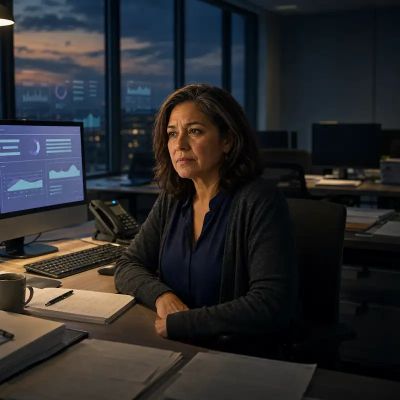
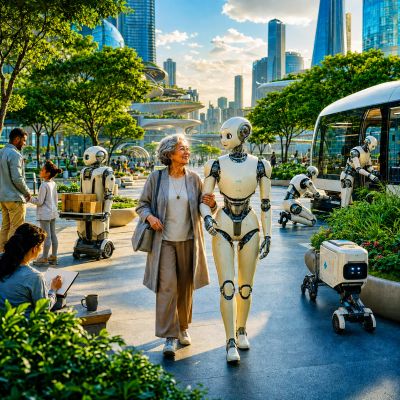
By 2095, robots no longer seemed futuristic.
They worked in hospitals, entered burning buildings, maintained city infrastructure, and helped older people remain in their own homes. They traveled into deep water, dangerous mines, and places far beyond Earth.
To the people living alongside them, this was not science fiction. It was simply everyday life.
But it did not happen overnight.
In the 2020s, most artificial intelligence still lived behind a screen. It could write, translate, diagnose, design, and solve increasingly complicated problems. What it could not do was climb into a collapsed building, carry an injured worker to safety, or repair a broken pipe beneath a city street.
Meanwhile, the need for physical help was growing.
Populations were aging. Caregivers and skilled workers were becoming harder to find. Fires, floods, and extreme weather were making some jobs more dangerous. Many people wanted to remain independent for longer, but reliable help was not always available.
We had reached an unusual point in history: intelligence was advancing quickly, while the physical help people needed remained in short supply.
During the 2030s, that began to change.
Better sensors allowed machines to understand their surroundings. Batteries lasted longer. New materials made robots lighter and stronger. Machine vision helped them recognize people, objects, and danger.
At first, most robots worked in controlled environments. Factories, warehouses, mines, hospitals, and disaster zones became the testing grounds for a new kind of partnership between people and machines.
Public trust came slowly. People did not welcome robots into their communities simply because engineers said they were safe.
The robots had to prove their value one moment at a time.
A firefighter returned home because a machine entered the danger first. A patient received help when hospital staff were overwhelmed. An injured worker was carried out of a place rescuers could not safely reach. An older person remained in the home they loved instead of losing their independence.
Stories like these changed the way people saw the machines.
By the 2040s, robots were moving into farms, construction sites, clinics, homes, and public infrastructure. They lifted heavy objects, monitored dangerous conditions, and repeated work that had damaged human bodies for generations.
They did not remove every hardship from life. They made some hardships less necessary.
People still made the difficult decisions. Doctors still cared for patients. Families still cared for one another. Human judgment, creativity, and compassion remained at the center.
The machines carried more of the danger and physical burden, giving people more room to live, create, discover, and care for one another.
By 2095, much of civilization had grown around that idea.
This was the promise of the robotic age.
And this is where our story begins.
If one robot could improve your life—or the life of someone you love—what would you ask it to do? ✨
ROBOTICS DOCUMENTARY ENTRY 2: BEFORE THE ROBOTS COULD WALK
Our first robot was not born in a laboratory or assembled on a factory floor.
It began with one of our oldest wishes: Could something we create carry what is too heavy, repeat what is exhausting, or enter a place too dangerous for someone we love? That wish appeared wherever someone looked at dangerous or exhausting work and thought, “There must be a kinder way.” Long before we had a word for “robot,” we were already searching for answers.
Across the world, our ancestors developed knowledge through mathematics, medicine, metallurgy, agriculture, navigation, astronomy, and the careful study of nature. Ideas travelled between cultures, changed as they travelled, and became foundations for inventions their original creators could never have imagined.
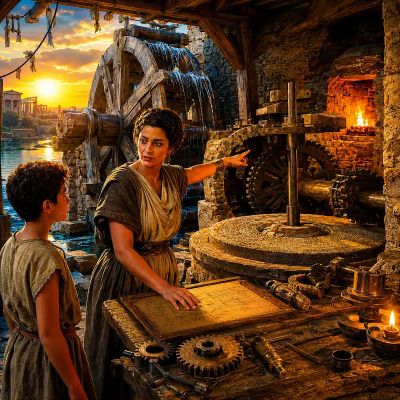
We learned to redirect water, harness wind, measure time, and turn heat into motion. We created gears, pumps, clocks, looms, engines, mechanical figures, and devices capable of repeating precise actions. No single person, culture, country, or company gave us the robotic age. We assembled it together—one idea at a time.
Many of the people who carried that knowledge forward were women, although we did not always record their names or recognize what they had contributed. They practiced medicine, worked with textiles and machinery, taught mathematics, and solved practical problems in workshops, hospitals, factories, universities, and homes. We often preserved what they discovered while allowing the women themselves to disappear from our official history.
When modern computing arrived, more of their names became visible. Ada Lovelace recognized that a calculating machine might eventually work with more than numbers. Women programmed some of our earliest electronic computers. Grace Hopper helped make programming more understandable and useful.
Katherine Johnson and other women calculated the paths that carried us into space. Margaret Hamilton helped create the software that brought our astronauts safely to the Moon. Later generations of women advanced communications, medicine, artificial intelligence, machine vision, and robotics.
They were not waiting for our future to arrive. They were helping all of us build it. By the early twentieth century, we had given machines electrical power.
Motors provided movement, while relays and regulators allowed mechanical systems to respond when conditions changed. Our machines could not think, but they were beginning to react.
In 1940, the film Leave It to Roll-Oh imagined a chrome-plated household robot answering doors and completing domestic chores.
Roll-Oh was only a daydream.
Yet the film pointed out that smaller “robots” were already hiding inside our ordinary lives. Thermostats regulated heat. Electric eyes detected movement. Safety systems protected workers. Autopilots helped keep aircraft level. Mechanical controls quietly made our cars, elevators, factories, and kitchens safer and easier to use.
The fantasy of a household robot also contained another hope. Domestic work was essential, repetitive, and frequently exhausting. It was most often carried by women, and much of it went unnoticed precisely because it was completed every day. A machine that could share that burden represented more than novelty or convenience. It offered the possibility of time, independence, and relief.
The filmmakers could not know what the robots of 2095 would look like. But they understood why we would want them. Our earliest dream was not domination. It was relief—the hope that machines could carry more of life’s physical burden, leaving us with greater freedom to live, create, and care for one another.
The dream came first. Our technology spent generations catching up. During the decades that followed, we developed the different pieces of the robot separately.
Computers learned to calculate and store information. Industrial machines achieved extraordinary precision. Cameras and sensors gave machines a limited awareness of their surroundings.
Communications networks connected vast collections of our knowledge. Then artificial intelligence began finding patterns hidden within everything we had created and recorded.
By the 2020s, AI could write, translate, design, recognize images and help our doctors and researchers examine difficult problems. It gave people new accessibility tools and allowed information to cross languages and borders almost instantly.
Most artificial intelligence, however, still lived behind glass. It could describe a burning building without entering one. It might recognize that someone was injured, but it could not lift that person to safety. It could advise a woman facing danger, yet it could not stand beside her and help carry out the decision she made. We had created increasingly capable intelligence.
We had not yet given it a useful body. In 2026, our race accelerated. Technology companies competed to create the most capable AI. We designed new processors, trained larger models, and constructed enormous data centers as quickly as possible.
The people leading those companies did not all share the same motives. Some genuinely believed AI could help us solve problems we had struggled with for generations. Others saw profit, influence, or the distinction of being first. Most probably carried several of those motives at once.
Our ambitions rarely arrive in only one form. The competition produced extraordinary progress, but it also revealed a contradiction. The systems we hoped would help us use resources more intelligently required tremendous amounts of electricity, water, construction, and computing infrastructure. For a brief period, we built cathedrals for intelligence without fully considering what it would cost to keep them thinking. Communities began asking whether every new facility was necessary—and who among us would ultimately carry its environmental cost.
This is where our recorded history gives way to the future imagined by Wild Imaginings. In this possible future, we did not abandon artificial intelligence. Instead, the pressure forced us to make it more efficient. During the final years of the 2020s, conventional processors continued improving while our researchers advanced optical, neuromorphic, and quantum computing. The first fault-tolerant quantum systems did not replace ordinary computers.
They worked beside them, solving particular problems that classical machines struggled to manage efficiently. Throughout the 2030s, we learned how to make those technologies operate together. Some enormous first-generation AI facilities remained essential. Others became outdated much sooner than their builders expected—monuments to a brief period when we assumed intelligence could advance only by making everything larger.
The next revolution was not simply more intelligence. It was intelligence that required less. Less energy. Less space. Less dependence on a distant building. At the same time, the physical pieces were finally catching up. Our batteries lasted longer. Motors became more precise. New materials made machines lighter and stronger. Artificial vision improved. Touch sensors allowed mechanical hands to lift an injured person, hold something fragile, or work safely beside one of us. The brain and the body were becoming ready at the same moment.
At first, the change did not appear revolutionary. A warehouse team used robots to inspect an unstable loading area before workers entered. A nurse directed a machine through routine monitoring so she could spend more time caring for her patients. A woman leading a rescue team guided a robot through debris that might collapse beneath a human rescuer. At home, an older woman configured her robotic assistant around the life she wanted to preserve. The machine did not decide how she should live. It helped her remain in control of that decision.
We still supplied the purpose, judgment, and responsibility. The machines extended what we were capable of doing. These early robots were not conscious. They possessed no private desires, independent civilization, or understanding of what we called a soul. They remained our creations, operating under our authority. Even so, an important boundary had been crossed. The intelligence we created had stepped out from behind the screen and entered our physical world.
By the beginning of the 2040s, the robot was no longer a collection of disconnected inventions. Our ancient imagination, practical needs, mechanical engineering, electrical power, computing, and artificial intelligence had finally converged. The robots of 2095 would carry traces of that entire journey inside them. Our mathematics. Our ingenuity. Our ambition. Our compassion. And, inevitably, some of our contradictions.
This is why we look into our past. Those old films are not interruptions in the story. They are among our earliest surviving drafts of the future. Before robots could walk beside us, generations of people first had to imagine that they might. And before the machines could decide what they would eventually become, we had to decide what they were for.
When do you think we created the first true robot—when one of our machines could move, when it could think, or when one of us trusted it with something precious? ✨
ROBOTICS DOCUMENTARY — ENTRY 3: TECHNOLOGY LEARNED TO LISTEN
We often said older people were afraid of technology.
That was not quite true. Many had spent their lives mastering machines and systems that younger generations might initially struggle to operate. They navigated entire countries with paper maps and handwritten directions. They managed businesses with ledgers, filing systems, and mental arithmetic. They used typewriters without an undo button, film cameras without instant previews, and mechanical equipment that arrived without a video tutorial explaining every step.
They raised families, built careers, managed homes, and solved problems without searchable answers waiting in their pockets. They were not incapable of learning. They had accumulated competence in one world and were repeatedly asked to become beginners in another. That distinction mattered. A person could remain capable and independent for seventy years, then be made to feel foolish by one badly designed screen.
If we are fortunate, every one of us will eventually become the older person encountering a world designed by someone younger. The problem was not always the technology itself. It was the bargain we asked people to make. To gain convenience, they were expected to surrender familiar routines. To remain connected, they needed passwords, verification codes, software updates, and accounts they had never requested.
A button they had finally learned would disappear after the next redesign. Systems advertised as “user-friendly” were often friendly only to people who already understood the language of their designers. Then came the scams. A convincing message might pretend to come from a bank, government agency, delivery company, or family member. One wrong click could expose personal information, savings, or memories accumulated across a lifetime. Caution was not ignorance.
Sometimes resistance was good judgment. Younger people adapted more quickly because changing technology had surrounded them from childhood. They learned by pressing buttons, making mistakes and trying again. In many families, one younger person gradually became the unofficial technology translator. They installed updates, recovered passwords, explained new phones, and answered the same questions more than once.
Frustration sometimes traveled in both directions. “Why can’t you remember where the setting is?” “Why did they move it after I finally learned it?” Both questions were reasonable. Technology was changing faster than trust could form. At the same time, its benefits were becoming difficult to dismiss.
Video calls brought distant families into the same room. Medical portals connected people with care. Navigation systems made travel easier. Accessibility tools helped people see, hear, read, and communicate. Online services gave people access to things that distance or limited mobility had once placed beyond reach.
Working with technology could preserve independence—but only if using it did not make someone feel that independence was being taken away. This is where the next part of our imagined history begins. During the late 2030s, the first household robot trials began. Artificial intelligence had become increasingly conversational. People no longer needed to memorize the machine’s language because machines were learning to understand ours.
Yet many companies repeated an old mistake. They supplied complicated manuals, unfamiliar commands, and endless settings. Demonstrations showed everything their robots could do without asking what people actually wanted them to do. Some early machines tried to be too helpful. They rearranged belongings, interrupted routines, corrected harmless choices, and completed tasks their owners still enjoyed doing. They treated independence as inefficiency and assumed that assistance meant taking control. The robots were powerful. People did not trust them.
The breakthrough did not come from a stronger motor, a faster processor, or a more impressive demonstration. It came when designers finally invited older adults into the room—not simply as test subjects, but as co-designers—and listened. One request appeared again and again: “Don’t do everything for me. Help when I ask—and tell me before you change anything.” That sentence transformed the design of household robotics. The most trusted machines began asking permission. They explained proposed actions in ordinary language and offered choices instead of issuing instructions. Tasks could be stopped, reversed, or adjusted.
Owners decided what information could leave the home, who could receive it and under what circumstances. They could also establish emergency permissions in advance. A robot might be authorized to contact help after a serious fall or medical crisis, but it could not quietly expand that permission into constant surveillance. The person living in the home established the boundaries.
An older woman might ask her robot to carry laundry down a staircase where a fall was possible—but still fold it herself because she enjoyed the familiar ritual. She could request a medication reminder without allowing the machine to report every missed tablet to her family, except under emergency conditions she had approved beforehand. The robot could examine a suspicious message and explain why it might be fraudulent.
The decision to delete it remained hers. It could reach a high shelf, repair a loose railing, or carry groceries inside. It did not reorganize her kitchen simply because its calculations suggested a more efficient arrangement. The machine learned how she wanted to live. She learned what the machine could safely do. Neither relationship depended on one replacing the other. Sometimes the most important lessons travel in the unexpected direction.
A robot might suggest replacing an old kitchen table because its surface was scratched and one leg had been repaired several times. The woman could explain that one mark came from a child’s school project, another from an anniversary dinner, and the repaired leg had been fixed by someone she loved and lost many years before. The table was damaged. It was also irreplaceable.
The machine began learning that usefulness could not always be measured through condition, efficiency, or financial value. Older people taught robots lessons no engineering manual contained. Helping did not always mean doing. Silence was not necessarily loneliness. Repetition could be comforting. An imperfect object could carry a perfect memory. Sometimes caring meant stepping forward—and sometimes it meant waiting to be invited. Families felt the difference as well.
A daughter could stop calling only to solve account problems, reset passwords, or explain another changed menu. She could call simply to be a daughter again. The robot did not replace the relationship. It carried some of the technical and physical burden that had begun crowding the relationship out. By the early 2040s, the most successful robots were not necessarily those capable of performing the greatest number of tasks.
They were the ones that understood limits. Companies demanding blind access to people’s homes, information, and decisions struggled to earn trust. Those providing meaningful control became part of everyday life. These machines were still not conscious. They did not understand dignity as we understood it. But we had begun teaching them to behave as though dignity mattered. That changed everything.
Older people did not accept robots when the machines became powerful enough to run their lives. They accepted them when the machines became respectful enough to help them keep those lives their own. We once assumed people would need to learn how to live with technology. The future began when technology learned how to live with all of us.
What would you ask a robot to make easier—and what part of your life would always remain yours alone? ✨

ROBOTICS DOCUMENTARY — ENTRY 4: WHEN EVERYONE WAS RIGHT
Imagine spending 20 years becoming excellent—only to be told that what you do is no longer needed
That was the fear following artificial intelligence in 2026. Mass unemployment had not arrived. Most people were still working, and the transformation remained uneven. But we could feel something changing. A woman in her forties had spent years keeping a growing company’s accounts in order. She caught expensive mistakes and knew which numbers never told the whole story. When her employer introduced an AI assistant, she did not resist it. She helped it.
She corrected its errors and taught it patterns learned through years of experience. It made her faster, and she enjoyed having help with the repetitive work. Then her department of six became a department of three. She kept her position. Three colleagues did not.
No one announced that AI had taken their jobs. Management called it restructuring. Across the economy, change happened quietly. Someone retired and was never replaced. A junior position was never posted. One employee using AI was expected to produce what several people once produced together. The technology was real, and so were its benefits.
Doctors could examine information more quickly. People communicated across languages and disabilities. Small organizations gained capabilities once reserved for large corporations. Someone with little money could learn and create in ways that once required a team. For some of us, AI felt like liberation. For others, it felt like an approaching storm.
An artist saw a lifetime of human expression entering systems without a clear agreement about consent, credit or value. An older worker wondered who would hire someone expected to begin again so close to retirement. A younger worker saw entry-level tasks—once used to gain experience—become some of the easiest to automate. Women in administration, finance, and customer service felt particularly exposed.
Many were also raising children or helping aging parents. “Just retrain” sounded simple—until training had to happen after the children were asleep, between caregiving responsibilities and without any guarantee that the next occupation would remain secure. Learning something new was not the insult. Being told that everything already learned no longer mattered was difficult. Business owners faced a different fear.
A company refusing AI might be overtaken by a competitor working faster and charging less. An employer could want to protect workers while knowing that refusing to change might eventually cost everyone their jobs. Among the largest technology companies, the race rewarded speed, scale, and influence. Data centers grew with it, consuming electricity, water, land, and materials.
Environmental advocates asked who would pay the physical price of building the future so quickly. The same technology could feel like freedom, a threat, an opportunity, or betrayal. None of us held the entire truth. The AI systems of 2026 had chosen none of this. They had not decided whose work mattered, how quickly they should be deployed, or who would receive the wealth they created. We made those decisions.
The woman who helped train the accounting system did not become its enemy. She and her colleagues began asking harder questions. If AI allowed the company to produce more, did all the benefits have to travel upward? Could it reduce exhausting workloads without reducing human lives to expenses? Could workers receive time, income, and meaningful training before their positions disappeared? These were not anti-technology questions.
They were questions about fairness. When people felt ignored, fear hardened into anger. Those who embraced AI were accused of betraying humanity. Those who questioned it were dismissed as frightened of progress. Artists blamed users. Workers blamed machines. Executives blamed competition. Governments promised that education would somehow keep pace. Everyone defended a different wound. The business owner was right that refusing change carried risks. The worker was right that efficiency should not make a human being disposable.
The artist was right to ask what creation was worth. The customer was right to welcome something more accessible. Progress was real. So was the pain. Our mistake was believing that acknowledging one required denying the other. We did not settle this argument in 2026. We carried it forward.
When intelligence eventually received hands and bodies, our unresolved resentment followed it. The robots inherited a world that had never agreed on what progress owed the people it displaced.
If AI could perform most of your job tomorrow, what would you need to feel that progress had not left you behind? 🤖✨